Students from ZP school speak Japanese
There is this Zilla Parishad school in Maan taluka of Satara district which is making news these days for making students fluent in Japanese language.
 Eduvarta
EduVarta News Network
Fascination for English language among Indian parents is not a new thing. And that’s the reason these days at every nook and corner you will find English medium schools. If this is the case with urban students, not much difference is there for parents from rural India too. But there has an exception. This one too has. There is this Zilla Parishad school in Maan taluka of Satara district which is making news these days for making students fluent in Japanese language. Yes, you heard it right! Not English but Japanese.
For more news updates just click here. https://www.eduvarta.com/en/
Apparently, this taluka is otherwise (in)famous for its drought. But the teacher in this school with his innovative experiments created love for the Japanese language among the students. School is located in Vijayanagar of Mann taluka. One of its teachers Balaji Jadhav always wanted his students to study on a global platform. He said, “we have seen every year thousands of students hit foreign lands for further studies. Although, America, Germany, Europe, Australia are few of the most sought destinations for higher studies, students find less opportunities as sometimes language becomes the barrier.
“I want my children to do globe trotting and thus I decided to teach them one of the foreign languages and I chose Japanese”, said , adding that he has students from grade 1 to four. In early years of growing up, children learn languages easily. ''Started a few months ago, the students can recognise words, phrases, numbers and amounts and read and speak easily. They can understand everything a Japanese person would be saying”, claimed Jadhav.
Also Read : Summer camps to build your kids persona
Explaining how he started with it, he said, “For first two to three weeks, we showed them videos in Japanese language on YouTube. After they understood some basic things, then moved on to showing them dialogues in Japanese. They showed interest. There are three types of scripts in the Japanese language, and we started teaching students the script called Hiragana. After learning a few letters of it, we used to rehearse reading and writing it in our spare time. Mainly DUolingo APP and YouTube helped us a lot”, he said.
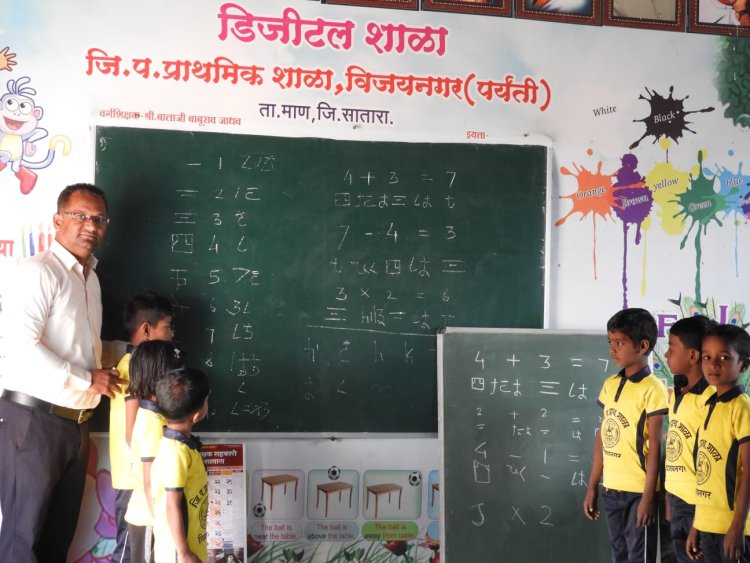
“Especially the students of class 1 were learning very easily. The school completed all aspects of letters, numbers, reading, writing, and communication well by giving it as much time as possible in two months. Any language is best learned through listening, speaking, reading and writing. Then I started taking small dialogues in groups of 4 to 5 lines. Then, by creating small words from letters, reading them and writing small words in Japanese script. Students can easily read and speak Japanese words, animals, birds, blows, months, fruits, flowers, relatives, actions, everyday words and sentences. It took about four months to learn all these things”, he informed.
“Then we started learning to read and write all numbers in Marathi and Japanese with emphasis on numbers and mathematics and now all the students not only recognize numbers but also write them in Japanese. Apart from that, addition, subtraction, multiplication and division are also being done in Japanese, said Jadhav. While people spend thousands of rupees on tuition classes to learn a foreign language, parents are very happy that these children are learning such a novel in such a rural area. Children speak small sentences even at home. Parents don't understand it. But they are happy and proud that they are learning something different. Each student is given a separate notebook for Japanese by the school and they practice it in that. Short words, sentences can now be written even by listening.
Innovative teachers like Balaji Jadhav have given rural students the opportunity to learn a different foreign language at such a young age. He is sure that all these students will benefit greatly in their future.